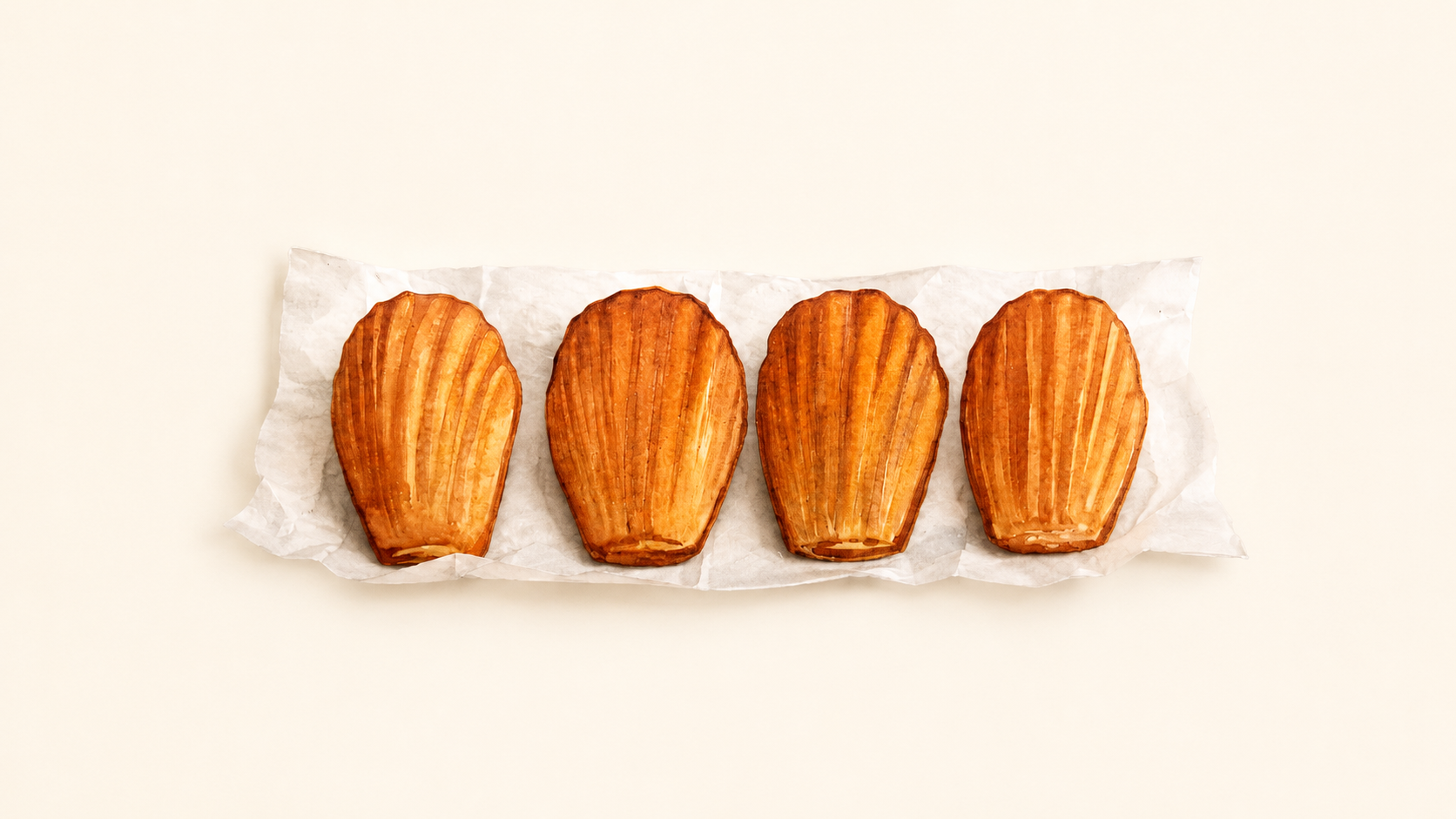
Proust's Madeleine, and What Lies Beyond
Scent does not store memory. It wakes it.
The most famous scene in Marcel Proust's In Search of Lost Time is the madeleine. The narrator dips the little cake into his tea, takes a bite, and is returned, instantly, to a Sunday in Combray. The scene has since become the standard reference for the way smell and taste summon memory. Psychologists call it the Proust Effect. The hypothesis is straightforward: olfactory signals travel directly to the limbic system, to the amygdala and the hippocampus, and so scent stirs emotional memory more forcefully than the other senses do.
But in Proust, the madeleine is only the opening. The seven volumes are dense with smell. The lilacs of Combray. The pomanders of the Guermantes. The scent in Albertine's hair. The salt air at Balbec. Proust does not simply describe these things. He uses them to rebuild time.
What is striking is how he writes about scent. He does not write the scent itself; he writes the scene the scent returns to him. When he describes lilac, he does not mention chemistry or color. He describes the garden in spring, the footsteps crossing the garden, the person to whom the footsteps belonged. The scent is the vehicle. The cargo is lost time.
This became, in time, a template. Proust handled time and memory through scent, and perfumers have read him ever since as a kind of textbook. Jean-Claude Ellena, in his own writing, quotes Proust often. He calls perfume a tool of memory.
The reason the madeleine has been cited for more than a century is simple. It shows, with great precision, what scent is capable of. Scent does not store memory. It wakes it.
Comments
Loading comments...